6
Academic Vocabulary
Vocabulary lesson helps teachers constantly build
students’ ability to access more complex texts
across the content areas. Lessons include Tier 2
and Tier 3 Vocabulary:
•
Tier 2 Core Vocabulary:
High frequency/
multiple meaning words
•
Tier 3 Academic Vocabulary:
Low frequency,
context-specific vocabulary
The Vocabulary Development section, based on
Marzano’s Six Steps for Teaching Vocabulary,
focuses on identifying new vocabulary, asking
students to restate descriptions, explain terms
in their own words, discuss vocabulary with one
another, and play games with the words.
ElAbecéVisualdelcuerpohumano
7
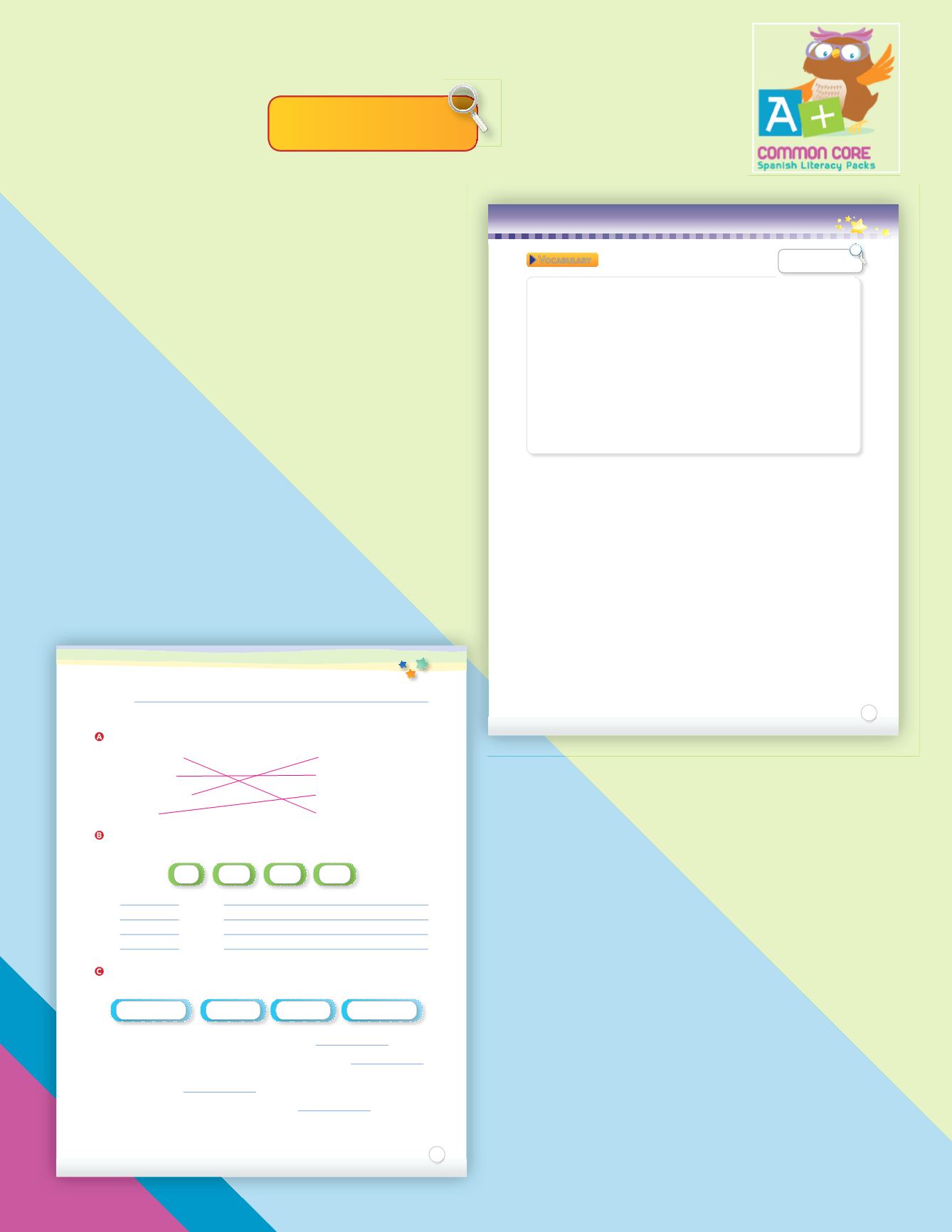
Nombre
Vocabulario
Une.
1
.
indispensable
a.
repetidamente
2
.
prolongarse
b.
extenderse
4
.
reiteradamente
c.
proporcionar
5
.
aportar
e.
necesario
Completa las palabras con el prefijo griego correcto y escribe una
definición. Después comprueba tu definición en un diccionario.
1
.
géneo:
2
.
tensión:
3
.
férico:
4
.
scopia:
Reemplaza lo que está en negrita con una palabra del recuadro y
escribe la nueva oración.
1
.
Los riñones eliminan los líquidos
que sobran
.
2.
Algunas personas tienen
tendencia
a la hipertensión.
3.
Cuando un hueso se rompe se forma una
parte abultada
que sobresale.
4.
El oído interno
hace posible
el equilibrio.
peri
homo
endo
hiper
protuberancia excedentes
posibilita predisposición
predisposición
protuberancia
posibilita
excedentes
homo
uniforme
hiper
tensión arterial alta
peri
en las afueras o alrededor
endo
exploración del interior del cuerpo
A+CommonCore Spanish Literacy Lesson Plan© SantillanaUSA
Lessons include vocabulary development
activities to help students apply the new
terms learned and help teachers gauge
student understanding.
3
ElAbecéVisualdelcuerpohumano
aportar
–
proporcionar algo
/ to provide
delimitar
–
fijar los límites de algo
/ to delimit
excedente
–
lo que sobra
(sustantivo)
, sobrante
(adjetivo) / excess
homogéneo
–
uniforme
/ homogeneous
indispensable
–
extremadamente necesario,
imprescindible / essential
integrar
–
ser parte de algo
/ to be part of
intervenir
–
tomar parte en algo
/ to take part
periférico
–
que está en las afueras o
alrededor de algo
/ peripheral
posibilitar
–
hacer posible
/ to make possible
predisposición
–
tendencia o inclinación
especial a algo
/ predisposition
prolongarse
–
extenderse
/ to extend
protuberancia
–
parte que sobresale de algo,
abultamiento
/ protuberance, bulge
reiteradamente
–
repetidamente
/ repeatedly
vincular
–
relacionar
/ to link
Advanced Vocabulary
conducto
–
canal o tubo por donde fluye una
sustancia
/ channel
dilatación
–
aumento de tamaño
/ dilation
estímulo
–
elemento externo que activa a un
cuerpo u órgano y causa una reacción
/ stimulus
excreción
–
desechos que se expulsan
/ excretion
filamento
–
algo en forma de hilo
/ filament
nódulo
–
masa redondeada
/ nodule
núcleo
–
parte central de algo
/ nucleus
orificio
–
agujero o abertura pequeña
/ orifice
óseo
–
relacionado con los huesos
/ bone
segregar
–
producir las glándulas del cuerpo
una sustancia
/ to secrete
toxina
–
sustancia venenosa o dañina
/ toxin
V
OCABULARY
V
OCABULARY
D
EVELOPMENT
¨
Introduce vocabulary by providing a description of all the words presented in the vocabulary
section and any additional vocabulary you may wish to discuss prior to the reading activities.
¨
Make sure students understand all the vocabulary needed to complete the activities (e.g.,
conclusión,
contexto, inferir, formal, generalización, predecir, prefijo, visualizar
) and instruction words, such as
cita,
clasifica, comparte, completa, describe, explica, infiere, justifica, organiza, predice, presenta, resume, revisa.
¨
Ask students to take turnsexplaining in theirownwords toapartnerwhateachwordmeans.Encourage
them tousecontextcluesand illustrations from thebookas theycomeupwith theirowndefinitions.
¨
Have student pairs classify the vocabulary terms based on the part of speech. Distribute the four-column
chart (Graphic Organizer #1) and have them label the columns
Sustantivo,Adjetivo,Verbo,Adverbio
. Once
student pairs have classified the vocabulary words, ask them to try to fill in as much of the chart as they
can. Model an example:
aportar (verbo)–aportación (sustantivo)– varios (adjetivo)–finalmente (adverbio).
¨
Remind students that analyzing the structure of a word will help them figure out its meaning.
Point out the prefix
pre-
in
predisposición
and explain that it means “before/prior to.”
Introduce
inter-
(between),
ex-
(outside), and
sub-
(under). Then have students explain the
meaning of
exhalar
(p. 26) and
subunidad
(p. 9). Explain that most scientific vocabulary has Greek
or Latin origins. Point out
homo-
(same) and
-géneo
(producing) in
homogéneo
and
peri-
(around) in
periférico
. Introduce
endo-
(inside),
hiper-
(excessive),
neuro-
(nerve), -
scopia
(exploration),
semi-
(half),
and
termo-
(heat). Then have students determine the meaning of
endoscopia
(p. 59),
intervertebral
(p.
14),
hipertensión
(p. 61),
neurotransmisor
(p. 35), and
semicircular
(p. 43).
¨
Point out words that may cause students spelling difficulties. For example:
bazo
(
spleen
) and
vaso
(blood vessel) on p. 53;
callo
(callus) on p. 16 and
cayó
(fell down);
sebo
(fat) on p. 25 and
cebo
(bait);
vello
(hair) on p. 25 and
bello
(beautiful). Then have students write sentences with these
homófonos
.
I
NSTRUCTIONAL
S
HIFT
:
Academic Vocabulary
A+CommonCore Spanish Literacy Lesson Plan© SantillanaUSA
I
NSTRUCTIONAL
S
HIFT
:
Academic Vocabulary


