


 157 / 164

 SHOP ONLINE www.santillanausa.com
I TECHNOLOGY SUPPORT
technicalsupport@santillanausa.comPROFESSIONAL DEVELOPMENT
155
Comprehensible Input and its Implications to the Bilingual, ESL and
Spanish Classroom
9781631135941 | Levels K–12
This session focuses on Second Language Acquisition theories as
presented by researchers (Krashen, 1981; Krashen & Terrell, 1983),
including Jim Cummins’s distinction between two types of language:
basic interpersonal communications skills (BICS) and cognitive academic
language proficiency (CALP). Participants learn how these theories can
help develop effective instructional strategies and assessments that guide
students along a continuum of language development—from cognitively
undemanding, context-embedded curricula to cognitively demanding,
context-reduced curricula (Robson, 1995).
Instructional Learning Strategies for the Bilingual/ESL Classroom
9781631135958 | Levels K–12
This session explores the meaning of bilingualism and effective bilingual
language program models, including transitional, dual-language, one
way and two-way bilingual, among others. Participants examine key
factors in the development of bilingual programs, implementation issues,
materials that most effectively support L1 and L2 oral language and
literacy development, and common transferable elements of L1 to L2
literacy. Participants learn how to develop effective instructional units and
compare, contrast, and evaluate examples of curriculum mapping, lesson
designs and model lessons.
Principles of Interactive Instruction
9781631135965 | Levels K–12
This session explores activity-based teaching and focuses on how teachers
can recognize what each learner brings to the classroom and the role they
play in their own language acquisition process. Since research on learning
and memory (Sprenger, 1999), on language acquisition and language
learning (Cameron, 2001), and on the functions of the brain (Genesee,
2000) confirms ELL are actively constructing schema (organizational
structures of language and content) and meaning, instruction should
motivate students to take active roles in their own learning. Participants
will learn how communicative teaching and learning focuses on authentic,
comprehensible, and interactive communication through a variety of
channels: teacher/student, student/teacher, student/student, student/
students, etc.
Developing Cross-Cultural Awareness and Multicultural Understanding
9781631135972 | Levels K–12
This session explores the importance of multiculturalism and pluralism
in the classroom and ways to better understand and serve different
student populations. Participants examine Banks’s (1997) dimensions of
multicultural education and discuss the importance of cultural differences,
strategies to appropriately respond to these differences, how cultural
differences may impact learning in math, science, and social studies; and
how to apply these principles to their own instruction.
ESL/ELD, BILINGUAL, AND DUAL-LANGUAGE SESSIONS (cont’d.)
NEW
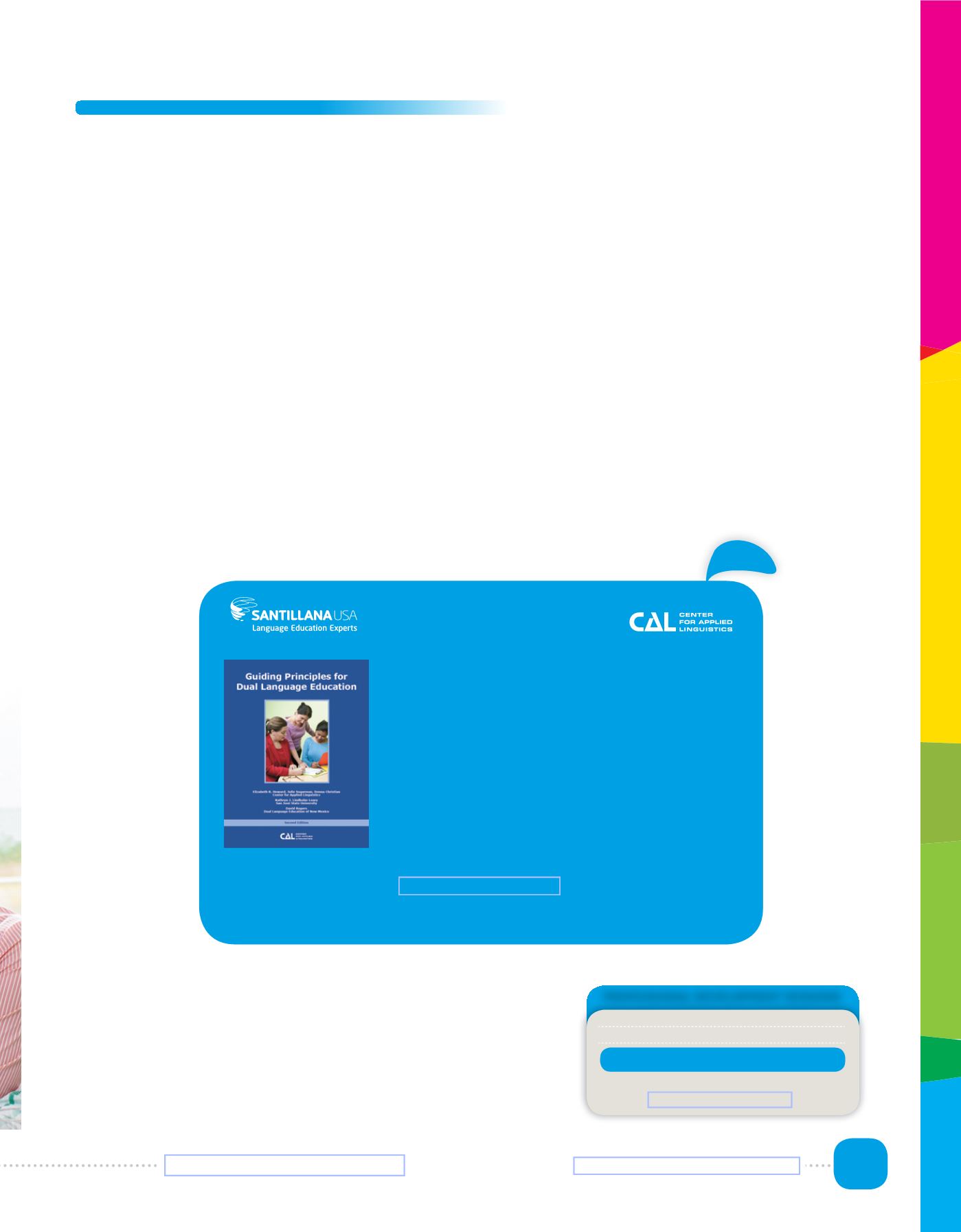
Dual Language Education Fundamentals Workshop
Featuring the Guiding Principles
for Dual Language Education
978-1-68292-106-7
The one-day workshop, presented by experts from the Center for
Applied Linguistics and Santillana USA, explores the research base
and key components of dual language programming and instruction
through the lens of the widely used Guiding Principles for Dual
Language Education. Participants learn the fundamentals of dual
language education, discover best practices and identify goals for
developing or enhancing an effective DL program on their campus.
Learn more and register for workshops online at
www.cal.org/cal-susa$500 per person.
Early bird and group discounts available.
Maximum of 35 participants
$3,500.00
Each additional participant
$50.00
FOR MORE INFORMATION:
Barbara Jones, PD Director
bjones@santillanausa.comPROFESSIONAL DEVELOPMENT SESSIONS